
Monoclonal antibodies (mAbs) are versatile molecules capable of customization to target nearly any disease. Beyond target affinity and biological activity, successful mAbs must exhibit robust stability to ensure manufacturability and safe administration. High-concentration formulations are increasingly important for subcutaneous and other low-volume delivery routes but increasing protein concentration can also amplify protein–protein interactions and the risk of self-association and aggregation. A critical bottleneck in the mAb development pipeline is the rapid identification of candidates with favorable developability profiles in the context of large library screens. Beyond the discovery phase, robust screening of late-stage mAbs in a diverse set of formulation conditions is challenging. Furthermore, reliance on the diffusion interaction parameter (kD) as a ranking tool to evaluate colloidal stability can obscure the true ranking due to the contributions of both kinetic and thermodynamic factors. The second virial coefficient (B22) provides an absolute thermodynamic measure of colloidal stability and can be used as a low concentration predictor of high concentration effects, but existing systems fail to deliver high-quality measurements in high-throughput. To meet this need, Malvern Panalytical has developed the high-throughput Zetasizer Core system, a single platform combining static light scattering (SLS), dynamic light scattering (DLS), and differential scanning fluorimetry (DSF) in an easy-to-use, plate-based format designed for high-throughput and laboratory automation.
Monoclonal antibodies (mAbs) are versatile molecules capable of customization to target nearly any disease. Beyond target affinity and biological activity, successful mAbs must exhibit robust stability to ensure manufacturability and safe administration. High-concentration formulations are increasingly important for subcutaneous and other low-volume delivery routes but increasing protein concentration can also amplify protein–protein interactions and the risk of self-association and aggregation. A critical bottleneck in the mAb development pipeline is the rapid identification of candidates with favorable developability profiles in the context of large library screens. Beyond the discovery phase, robust screening of late-stage mAbs in a diverse set of formulation conditions is challenging. Furthermore, reliance on the diffusion interaction parameter (kD) as a ranking tool to evaluate colloidal stability can obscure the true ranking due to the contributions of both kinetic and thermodynamic factors. The second virial coefficient (B22) provides an absolute thermodynamic measure of colloidal stability and can be used as a low concentration predictor of high concentration effects, but existing systems fail to deliver high-quality measurements in high-throughput. To meet this need, Malvern Panalytical has developed the high-throughput Zetasizer Core system (Figure 1), a single platform combining static light scattering (SLS), dynamic light scattering (DLS), and differential scanning fluorimetry (DSF) in an easy-to-use, plate-based format designed for high-throughput and laboratory automation.
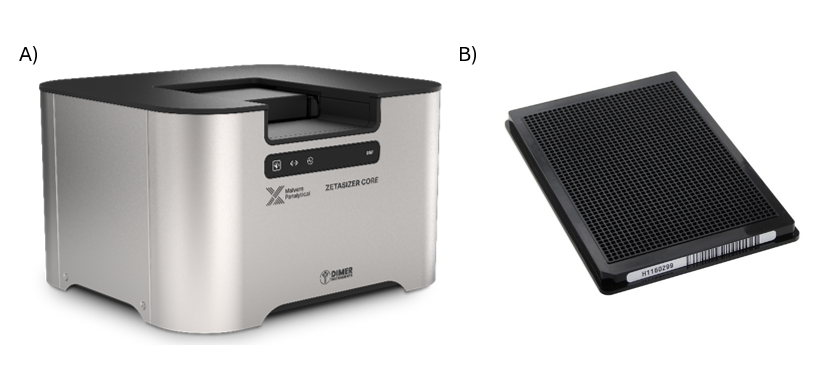
Figure 1. An easy-to-use 3-in-1 system. A) Zetasizer Core is a 3-in-1 system with static light scattering (SLS), dynamic light scattering (DLS), and differential scanning fluorimetry (DSF) capabilities. B) The Zetasizer Core is a plate-based system handling standard 1536, 384, and 96 well plates as well as a built-in bar code scanner to assist in library screening.
Both structural and colloidal stability influence the propensity of a protein to become aggregated. Structural stability is governed by intramolecular interactions within the protein chain to maintain the properly folded state. The melting temperature (Tm) is commonly used to characterize thermal stability and represents the midpoint of a protein unfolding transition. For a given protein and measurement condition, higher Tm values generally indicate greater resistance to thermal unfolding and can be useful for ranking candidate constructs or formulations. Proteins with lower Tm have a higher propensity towards unfolding and subsequent aggregation. The temperature at which unfolding begins (Ton) can also be calculated. The Zetasizer Core system utilizes tryptophan fluorescence as a label-free method to determine Tm with the capacity to measure up to 192 samples per minute. A dedicated SLS detector allows the user to couple DSF with SLS to provide aggregation monitoring and pinpoint the aggregation temperature (Tagg).
Colloidal stability involves intermolecular interactions between protein molecules in solution, where net attractive interactions between molecules promote self-association and aggregate formation. Both DLS and SLS measurements can provide insights into colloidal stability through their respective interaction parameters calculated through a concentration series. The diffusion interaction parameter (kD), obtained from DLS measurements, reflects the concentration dependence of particle diffusion and provides an indirect measure of protein–protein interactions. Because kD is influenced by both thermodynamic and hydrodynamic effects, it is particularly useful for comparing formulations and ranking conditions within a given molecule.
In contrast the second virial coefficient (B22), obtained from SLS measurements, directly characterizes the thermodynamic contribution of protein–protein interactions and provides a reliable quantitative parameter for comparing the interaction behavior of different molecules and formulations. The dedicated SLS photodiode detector provides a broad linear measurement range that supports measurements at the elevated protein concentrations relevant to mAb formulation development. Positive values of both kD and B22 indicate net repulsive interactions under the conditions tested, while negative values indicate net attractive interactions. Both kD and B22 can be measured on the same plate and the ZS Discover software for the Zetasizer Core features a Colloidal Stability Wizard to make setup easy and produce results in just 5-clicks.
Together, these measurements provide complementary insight into structural and colloidal stability, enabling researchers to identify potentially problematic candidates or formulation conditions earlier in development and prioritize those with more favorable developability profiles.
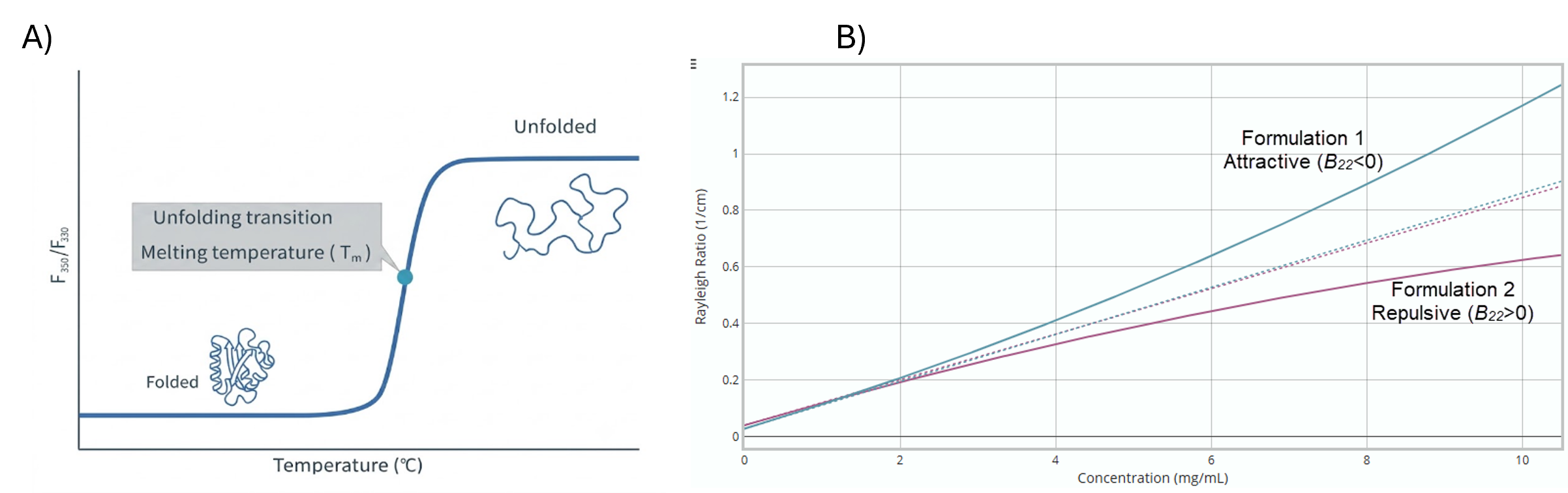
Figure 2. Key Stability Parameters. A) The Zetasizer Core utilizes intrinsic tryptophan fluorescence to calculate Tm. B) B22 describes thermodynamic interactions between protein molecules.
Both the pH and ionic strength of the solvent are common variables in formulation screens used to pinpoint the most stable environment for the product. Proteins contain several amino acids with ionizable side chains (aspartic acid, lysine, etc.) that are sensitive to changes in the pH and contribute to the overall charge exhibited by the molecule. Canonical sidechain pKa values (3.9 for aspartic acid, 10.8 for lysine, etc.) are defined for the free amino acid, but within a folded protein the local electrostatic environment perturbs these values, making the net charge at a given pH difficult to predict from sequence alone. The isoelectric point (pI) corresponds to a condition where the protein has no net charge. Because electrostatic repulsion is reduced near the pI, proteins may exhibit increased self-association or aggregation under these conditions. Ionic strength can further influence these interactions by screening electrostatic forces between charged protein molecules. Increasing salt concentration can therefore reduce electrostatic repulsion and, depending on the protein and formulation conditions, promote self-association or aggregation.
Whereas typical buffers are effective for a particular pH range, the Britton-Robinson buffer acts as a universal buffer titratable to pH 2-12 without changing composition. Bovine immunoglobulin (bIgG, Sigma Aldrich I5506) was resuspended in Britton-Robinson buffer at different pH values and salt concentrations. The Zetasizer Core was used to obtain all stability parameters B22, kD, Tm/Ton, and Tagg at all conditions.
BIgG was resuspended in Britton-Robinson buffer titrated to pH 4, 6, 8 with addition of 10 mM NaCl (low ionic strength) or 100 mM NaCl (high ionic strength) and stability parameters as B22, kD, Tm/Ton, and Tagg were obtained running all conditions on the Zetasizer Core (Figure 3). The results are represented in Table 1. At pH 4.0 and low ionic strength, bIgG exhibits positive B22 and kD values, indicating net repulsive protein–protein interactions and favorable colloidal stability, despite the pH 4.0 conditions showing the lowest structural stability of the set. Under these conditions, the separation between the onset of unfolding and aggregation demonstrates that thermal unfolding does not immediately result in aggregation, indicating that the partially unfolded state is tolerated in solution. The relationship between Tm and Tagg further illustrates the importance of measuring both structural and colloidal stability. Increasing the NaCl concentration from 10 to 100 mM reduces electrostatic repulsion, resulting in less favorable colloidal interactions and aggregation at lower temperatures and/or protein concentrations. This comparison highlights how a formulation can exhibit relatively poor structural stability while maintaining sufficient colloidal stability to delay aggregation.
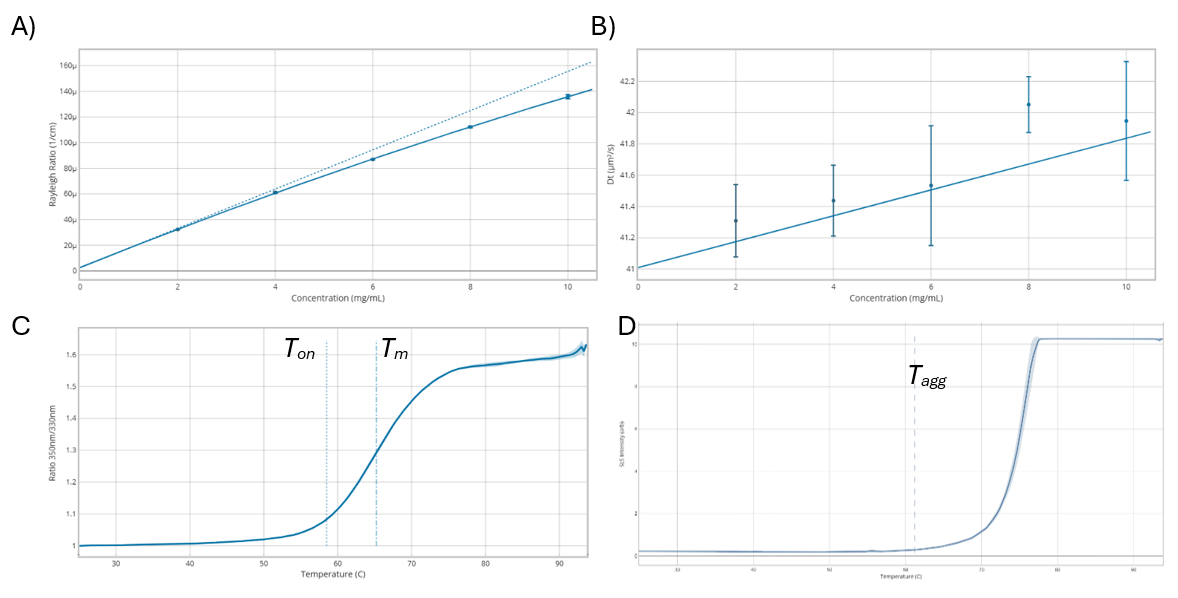
Figure 3. Representative B22, kD, Tm/Ton, and Tagg Plots from 10 mg/mL bIgG in pH 4.0+10 mM NaCl Condition. A) Rayleigh Ratio plot used to determine B22 from SLS measurements. B) Dynamic Debye plot used to determine kD from DLS measurements. C) Ratio of fluorescence intensity at 350 nm and 330 nm used to determine Tm and Ton. D) SLS intensity is utilized to determined Tagg.
The apparent molecular weight ranges from 194 to 231 kDa, exceeding the expected 150 kDa mass of an IgG monomer. A weight-average mass is reported by SLS measurements with the value weighted towards the largest species present. As the bIgG is purified from serum as a polyclonal mixture, there is likely to be a minor population of dimers. The lowest apparent molecular weight is observed at pH 4.0 with 10 mM NaCl, which is consistent with a more repulsive and therefore least self-associated condition. Increasing the pH from 4.0 moves into the pI range of bIgG (approximately pH 5.5–8.3) and toward neutral conditions increases the structural stability of bIgG, with Tm rising by roughly 6–8 °C at 1–2 mg/mL. However, this improvement in structural stability is accompanied by a decrease in colloidal stability as the kD and B22 values become negative, indicating attractive intermolecular interactions.
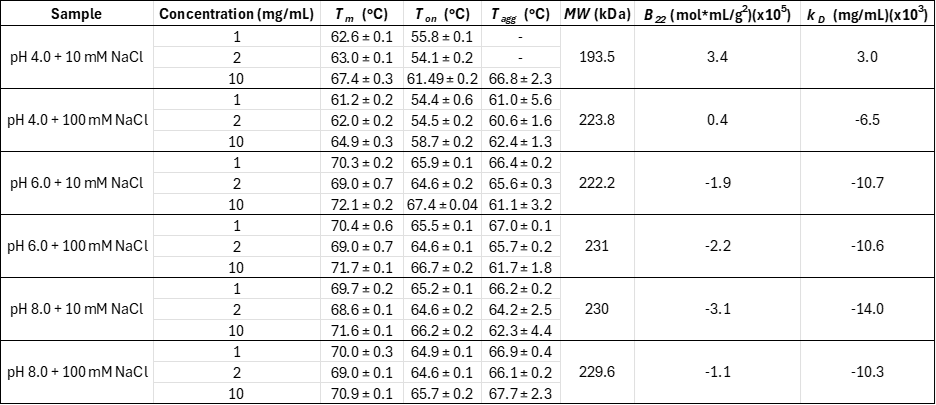
Table 1: Stability Parameters
Plotting kD against B22 for all six conditions shows that the two parameters track one another in rank order, with the most repulsive conditions by B22 also returning the highest kD (Figure 4). Consistent ranking is not the same as consistent classification. At pH 4.0 with 100 mM NaCl (Figure 4, red outline), kD is negative while B22 remains positive; a screen relying on the sign of kD alone would flag this condition as attractive when the thermodynamic interaction is in fact repulsive. This is a recognized limitation of DLS-only interaction screening. Because the Zetasizer Core acquires kD and B22 from the same wells in the same run, conditions can be ranked by kD and classified unambiguously by B22 without additional sample, plate setup, or instrument time.
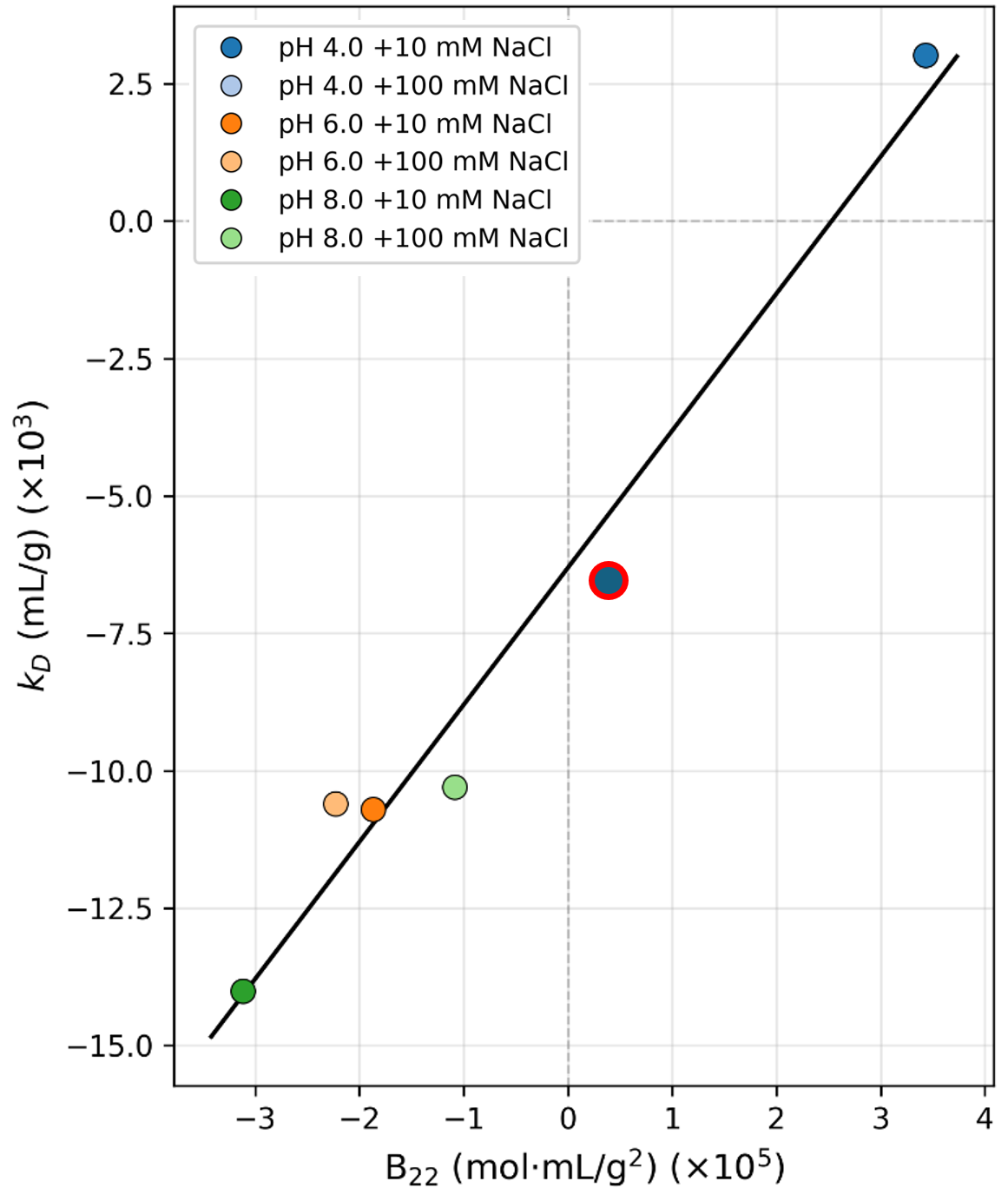
Figure 4. kD vs. B22 Plot showing the importance of measuring B22 directly instead of relying on apparent kD. B22 & kD disagree for the pH 4.0 + 100 mM NaCl (red outline).
Importantly, no single stability parameter fully describes the developability profile of a protein. Conditions that improve structural stability may not necessarily improve colloidal stability, highlighting the value of combining orthogonal measurements when screening mAb candidates and formulations.
The combination of structural and colloidal stability measurements is essential for identifying antibody candidates and formulations with favorable developability profiles. As demonstrated with bovine IgG across a range of pH and ionic strength conditions, thermal stability (Tm) and colloidal interaction parameters (kD, B22) can move independently of one another — and even the two colloidal parameters can occasionally diverge in classification, despite tracking closely in rank order. Robust developability screening therefore depends on capturing multiple, orthogonal measurements from the same samples, under the same conditions, without added time or material burden.
The Zetasizer Core was purpose-built to meet this need. By integrating SLS, DLS, and DSF into a single plate-based platform, it enables Tm, Tagg, kD , and B22 to be determined from the same wells in a single run — eliminating the ambiguity that can arise from relying on any one technique or parameter in isolation.
With throughput of up to 192 samples per minute, compatibility with 96-, 384-, and 1536-well formats, and streamlined workflows such as the 5-click Colloidal Stability Wizard in ZS Discover software, the Zetasizer Core allows researchers to move beyond single-parameter screening and build a complete, multidimensional stability profile early in development. This positions the Zetasizer Core as a powerful, high-throughput solution for de-risking candidate selection and accelerating the path to manufacturable, high-concentration antibody formulations.