Fragment screening of GPCRs using grating coupled interferometry (GCI) technology
A reliable solution for unstable proteins


A reliable solution for unstable proteins
particle size
interaction analysis
wavechip
Introduction
Recently, Evotec successfully harnessed Grating Coupled Interferometry (GCI) technology for fragment screening against G protein-coupled receptors (GPCRs), as Dr. Edoardo Fabini, Principal Scientist at Evotec, explains.
“The key aspect of GPCRs is their low surface activity, as they are very unstable once they are removed from their natural membrane environment.” As a result, “having a fast and sensitive technology like GCI opens up new possibilities when it comes to quantifying low-signal, weak binding events with confidence..”
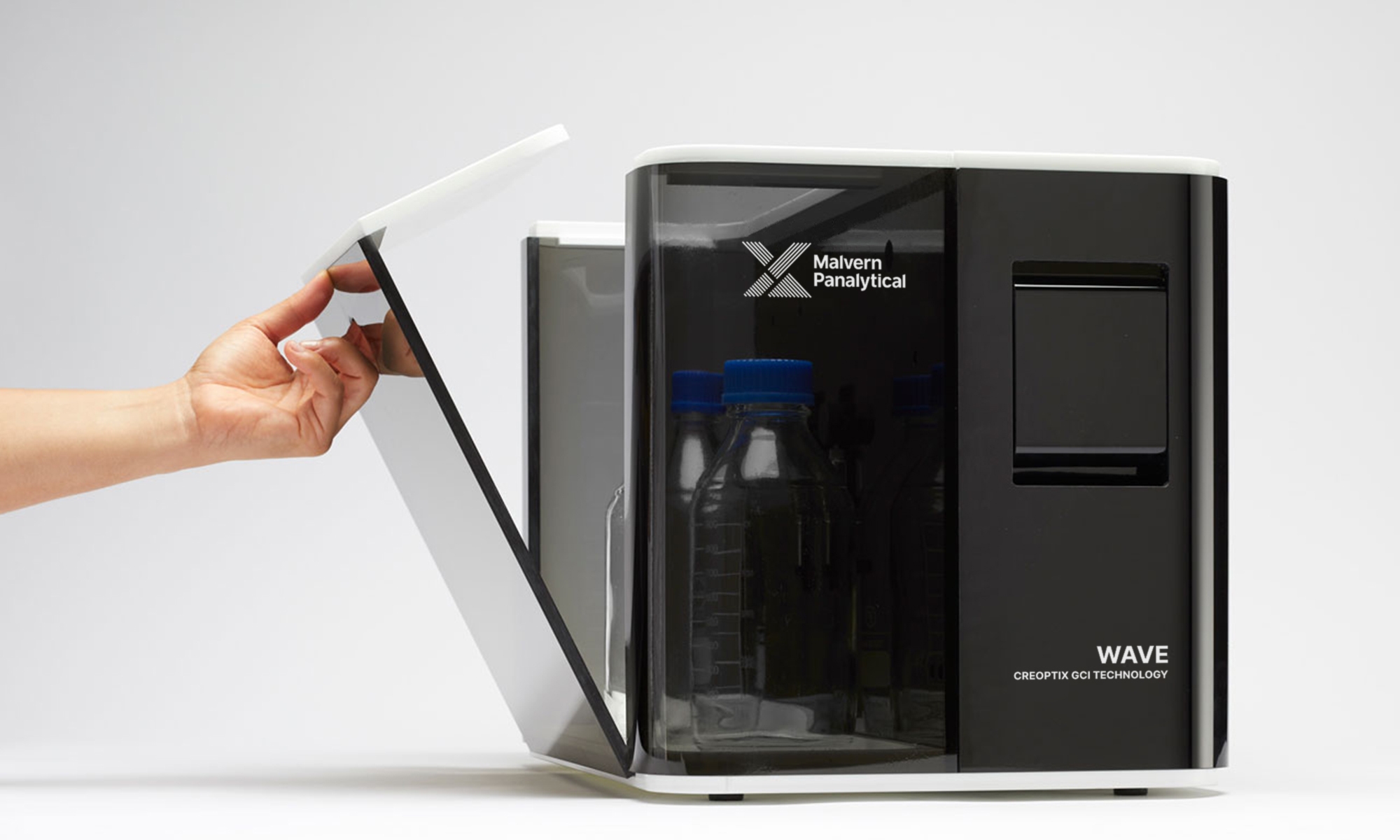
In a recent webinar hosted by Malvern Panalytical, Dr. Fabini walked attendees through the challenges that come with studying GPCRs, and the solutions provided by the WAVEsystem, which is engineered around our proprietary GCI technology.
Maintaining surface activity
When removed from their native environment, GPCRs deteriorate quickly.
The WAVEsystem and waveRAPID provide a double improvement. Firstly, assays can be rapidly optimized to select the optimal protein construct. Taking advantage of all four sensor surfaces, testing a series of constructs against control compounds allows the experimentalist to identify the optimal constructs and conditions that have the highest chances of producing a robust screening assay to pursue further with structural studies. This can be done in hours rather than days with waveRAPID. Researchers can screen more analytes using waveRAPID compared to traditional biosensor-based methods – as a result the membrane protein sensor surface will have less time to lose surface activity.
“When you work with challenging targets such as membrane proteins, having the right construct for downstream studies is key to success. Using waveRAPID technology, protein material recovered during small-scale expression and purification can be readily immobilized on the sensor surface. Functionality can be quickly probed to identify constructs that provide high quality results and are worth pursuing for mid/large-scale production.”
Dr. Edoardo Fabini — Evotec

Working with crude samples
The non-clog WAVEchip vastly reduces the time spent on protein purification and can even remove this step altogether.
“Not being afraid of clogging the IFC* allows us to reduce purification steps and get material quickly to binding studies, which can greatly help maintain higher protein functionality”
The WAVEchip integrates all the instrument’s microfluidics - which add to the instrument’s preciseness and allows the use of a very small quantity of fluid - into a disposable cartridge rather than the device core. It also places large bore standard valves downstream to the instrument instead of having the microvalves
near the chip. This minimizes the risks of clogs, allowing less purified samples to be analyzed with peace of mind, and preventing instrument downtime for unclogging.
“Previously, our workflow used to involve many steps that took time away from analyzing fragment interactions. By greatly reducing the time spent on purification, the WAVEsystem allows us to spend more time doing what’s the most important for our research.”
The innovative design of our patented WAVEchips supports crude samples, pathogenic samples, harsh solvents, and large particles up to 1,000 nm, normally only achieved with plate-based assays. As Dr. Fabini states:
“Being able to perform harsh cleaning often, without risking damaging/altering the IFC*, helps us to have a sharp system with the highest sensitivity when it matters. There are no issues with quickly switching between different biological system from one day to the next.”
Reliable measurements even with low surface stability
Traditional biosensor-based methods can struggle to detect weak fragment interactions with GPCRs; furthermore, the GPCR biosensor can even lose activity over time. This is particularly troublesome given the intrinsic instability of GPCRs. As noted by Dr. Fabini:
“Having a fast and sensitive technology like GCI opens up new possibilities when it comes to quantifying with confidence low-signal, weak binding events.”
GCI boasts extremely high sensitivity compared to traditional biosensor-based methods. Our Wavechips with parallel flow channels enable ultra-fast transition times. Furthermore, it provides reliable determination of off-rates up to 10 s-1, and superior signal- to-noise ratios (0.01 pg/mm2 at 1 Hz).
As a result, even weak interactions with low biosensor surface activity can be detected. This is further enhanced by the WAVEsystem’s speed, as the shorter experiment time entails a lower loss of membrane protein activity.
Limit non-specific binding interactions
Non-specific binding (NSB), where an analyte binds to an unintended location such as the detergent or micelles, can result in complexities during data interpretation. The lipophilicity of GPCRs mean they tend to clump into micelles, leading to NSB.
However, by performing very fast measurements, waveRAPID ensures a short contact time between the analyte and surface, thereby limiting the potential for non-specific binding.
“Keeping injections length as short as possible allows less time for secondary interactions to build up and give more relevance to the primary “high affinity” interaction. We like to be able to cleanly detect the unbinding process of the ligand-target complex and use the kinetic component to infer complex stability even with a single concentration.”
Dr. Edoardo Fabini — Evotec
Surpass these challenges with ease
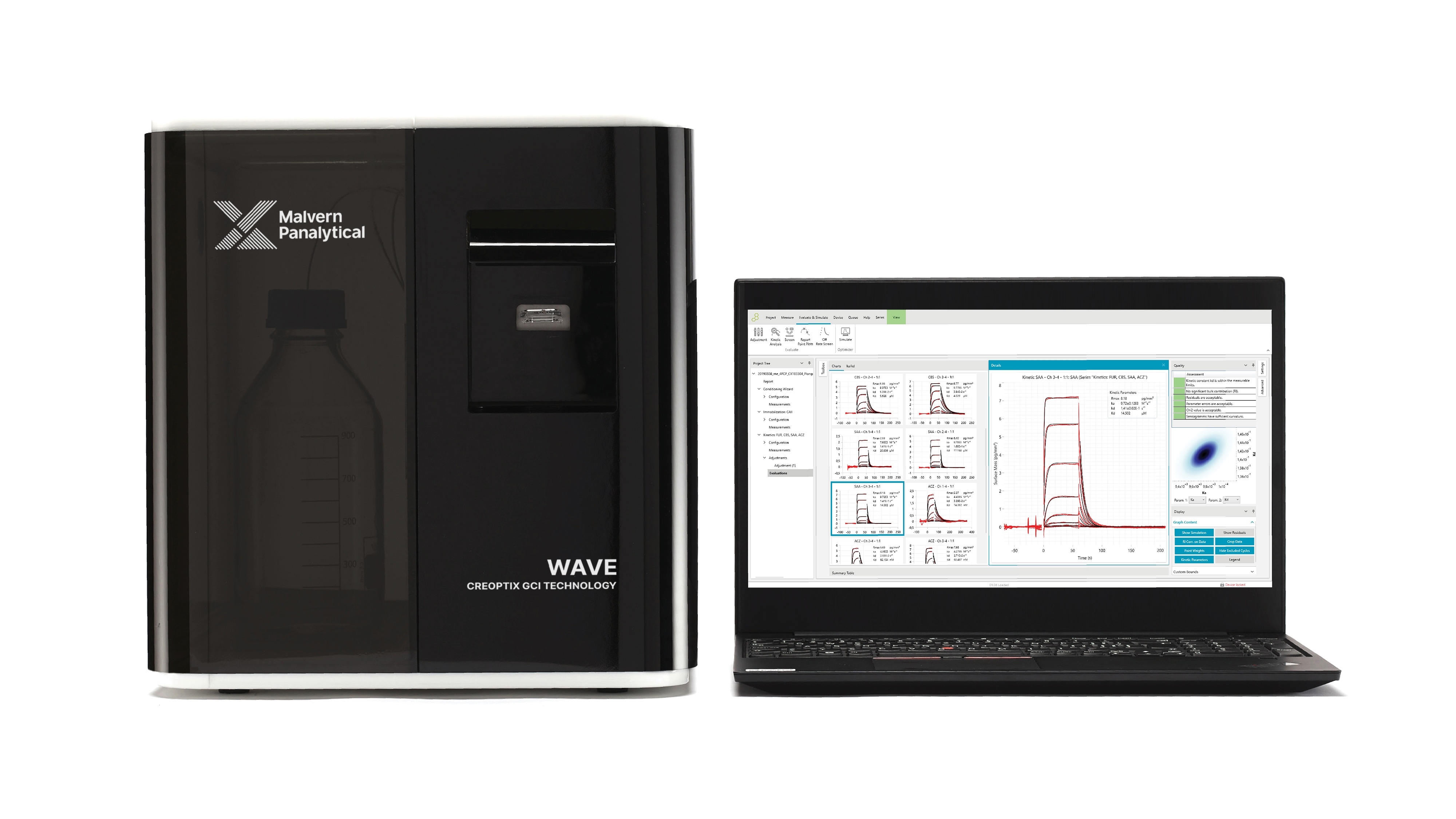
The WAVEsystem’s WAVEcontrol software provides superior and simplified data analysis for a wide range of sample types and sizes. The software helps you move seamlessly from sample to data in a simple step-by-step process, generating outputs at the touch of a button. Every step, from assay setup to data evaluation and report writing is simplified with an intuitive design that mirrors the way you work.
Meanwhile, through the Direct Kinetics 1-click evaluation tool, you can obtain automated calculations of your kinetic parameters with mathematically sound error analysis. Hundreds of interactions are automatically analyzed in 3-5 minutes. Direct Kinetics thus enables quick decision-making, fewer errors, increased ease of use, and ensures reproducible data.
Overall, the WAVEsystem can transform workflows, turning projects that would take weeks into processes that take days.
Dr. Fabini was able to:
“hit screen a library of 5,500 fragments against six targets in just three weeks. Thanks to the WAVEsystem’s speed and flexibility, Evotec can conduct screenings quickly, and for a broad variety of applications.”